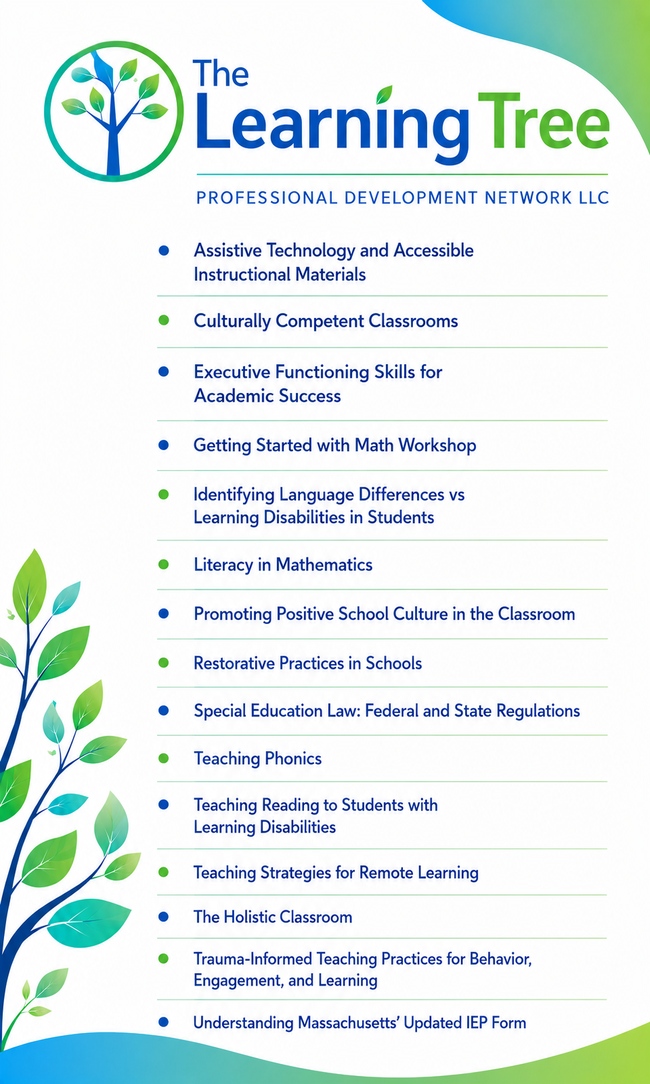

Assistive Technology and Accessible Instructional Materials - Summer 1B: 6/14/26 - 7/25/26
This course is designed as an introductory overview in the application of assistive technology in the general education setting in compliance with IDEA requirements. The course will cover the continuum of Assistive Technology devices, universal design for learning, curriculum adaptation and integration of best strategies and practices, accessible educational materials, state resources, and assessment and evaluation protocols. Family involvement in all phases of service delivery will also be discussed.
$300.00

Culturally Competent Classrooms - Summer 1B: 6/14/26 - 7/25/26
This course is designed to provide educators with an overview of the essential components in creating a culturally competent classroom. Participants will evaluate the Competencies of a Culturally Competent Classroom and learn how to implement evidence-based best Inclusive Practices. Course topics will explore Teaching Tolerance and cultural competency aligned to the principles of Universal Design for Learning, Positive Behavioral Interventions and Supports, and Social Emotional Learning.
$300.00

Executive Functioning Skills for Academic Success - Summer 1B: 6/14/26 - 7/25/26
Executive functioning skills are critical predictors of academic success across grade levels. This graduate-level course examines the cognitive processes that support planning, organization, self-monitoring, time management, and goal-directed behavior in school settings. Participants will explore how executive functioning deficits affect learning, behavior, and independence for diverse learners. The course emphasizes explicit instruction, classroom-based interventions, and schoolwide supports that strengthen executive functioning skills. Educators will analyze research-based frameworks and design practical tools that promote academic independence and self-regulation. This course is appropriate for general educators, special educators, and instructional leaders seeking to integrate executive functioning instruction into daily practice.
$300.00

Getting Started with Math Workshop - Summer 1B: 6/14/26 - 7/25/26
Getting Started with Math Workshop is designed to introduce participants to a structure for teaching math that supports each child’s development in order to maximize math proficiency in grades K through 8. Participants will gain strategies for engaging students in standards-based, rigorous, and meaningful learning opportunities where the teacher focuses on a particular concept, strategy or skill. Course participants will learn to implement and facilitate math workshop in the classroom, including scheduling, designing stations or centers, lesson planning, differentiation, and assessment. Various models of math workshop will be studied.
$300.00

Identifying Language Differences vs Learning Disabilities in Students (Formerly Distinguishing Language from Learning Disability) Summer 1B: 6/14/26 - 7/25/26
$300.00

Literacy in Mathematics - Summer 1B: 6/14/26 - 7/25/26
Reading and writing in mathematics are of particular interest to educators because these processes are essential to both problem solving and concept development in mathematics. This course will expose participants to various strategies for incorporating literacy into math lessons in order to meet Common Core State Standards and accelerate student success in grades K through 8. Strategies for teaching literacy in math will be explored through the topics of vocabulary, speaking and listening skills in math, using literary and expository texts in math, mathematical reading comprehension, assessments, and writing about math.
$300.00

Promoting Positive School Culture in the Classroom - Summer 1B: 6/14/26 - 7/25/26
This course is designed to provide educators with an overview of the essentials required in a positive school and classroom culture. Participants will learn the components of positive school and classroom communities. The components of bridging the home school connection will be covered as well as community involvement in schools. Topics covered will include zero tolerance, bullying, creating a supportive school, service learning, teaching social responsibility, connecting with diverse families, and more.
$300.00

Restorative Practices in Schools - Summer 1B: 6/14/26 - 7/25/26
Participants will learn to understand and implement restorative practices as a framework for building community and for responding to challenging behavior through authentic dialogue, coming to a collective understanding, and moving forward in a positive direction. Course topics will explore building positive cultures and communities, Positive Behavior Interventions and Support (PBIS), the group process, as well as conflict resolution and behavior management through the lens of restorative practices.
$300.00

Special Education Law: Federal and State Regulations - Summer 1B: 6/14/26 - 7/25/26
This course will explore the major legal documents that govern the provision of services and discipline of students with disabilities. Participants will be introduced to federal and state special education laws and regulations through the lens of both general and special educators. Particular attention will be given to IDEA, ESSA, Special Education mandates (state & federal), and Section 504 of the Rehabilitation Act eligibility criteria.
$300.00

Teaching Phonics - Summer 1B: 6/14/26 - 7/25/26
Teaching Phonics provides educators with an in-depth exploration of phonics instruction and equips them with the knowledge and skills to effectively teach phonics to students. Participants will delve into the fundamental concepts of phonics, including the pre-requisite skills necessary for acquiring phonics skills, the role of phonological awareness in phonics instruction, the significance of orthographic mapping in phonics skill development, and the distinction between sight words and high-frequency words.
$300.00

Teaching Reading to Students with Learning Disabilities - Summer 1B: 6/14/26 - 7/25/26
This course is an overview of research, theory, and best practices in the fields of reading and learning disabilities. Participants will study content and teaching approaches focusing on reading for preK-12 students with learning disabilities. Topics include evidence-based approaches for promoting growth in phonemic awareness, phonics, reading fluency, vocabulary development, and comprehension. Participants will learn a variety of specific modifications and interventions based upon individual needs and designed to address and remediate learning problems as specified by the I.E.P.
$300.00

Teaching Strategies for Remote Learning - Summer 1B: 6/14/26 - 7/25/26
Teaching Strategies for Remote Learning increases educators' ability to teach remotely. Participants learn about the Foundations of Virtual Learning, including the most recent and best practice research. This course will expand participant knowledge of best practice strategies based upon the current research on the science of Virtual Learning. Teaching strategies will target Virtual Instruction and Classroom Management in the remote classroom. Course participants will also learn strategies to remotely teach and support Social Emotional Learning as well as how to increase the remote Home/School Connection.
$300.00

The Holistic Classroom - Summer 1B: 6/14/26 - 7/25/26
This course will explore the neurological process of executive function (goal-directed behavior, planning, organization, and impulse control) and the negative impact that stress is having on student learning and achievement. Participants will evaluate and learn to implement activities for improving students’ working memory, emotional regulation, and resilience. Topics covered will include the mind-body connection, mindfulness, grit, yoga, and movement-based learning, promoting pro-social behaviors and general well-being of learners. Participants will gain strategies for incorporating holistic components into their classrooms and schools.
$300.00

Trauma-Informed Teaching Practices for Behavior, Engagement, and Learning (Formerly Trauma Informed Education) Summer 1B: 6/14/26 - 7/25/26
$300.00

UNDERSTANDING MASSACHUSETTS' UPDATED IEP FORM - Summer 1B: 6/14/26 - 7/25/26
Navigating Massachusetts' Updated IEP Form offers educators a comprehensive exploration of the recent changes to the Individualized Education Program (IEP). This course equips participants with essential knowledge and tools to effectively understand and implement the revised Massachusetts IEP form.
$225.00